
A new Horus Heresy novel has ignited debate among Warhammer 40,000 lore enthusiasts regarding the true state of the Emperor and the Golden Throne. It also raises the possibility that two classic early artworks may provide an official glimpse into this universe.
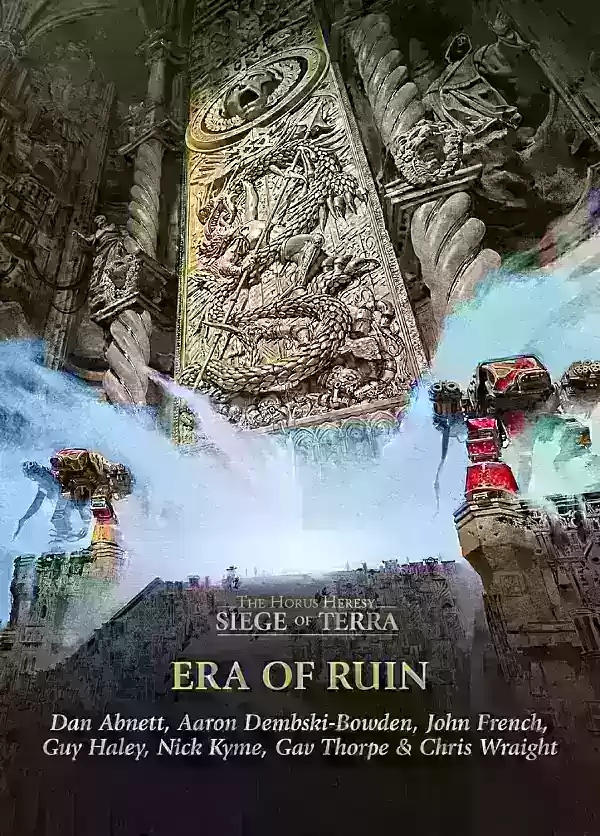
Era of Ruin, whose special edition caused the Warhammer.com website to crash during its pre-order launch, is a collection of short stories that conclude the Horus Heresy narrative. This galaxy-wide civil war between loyalist and traitor Space Marines took place 10,000 years before the current Warhammer 40,000 timeline. In the Horus Heresy, the Emperor ultimately defeated his Chaos-corrupted son, the primarch Horus Lupercal, preserving the Imperium of Man from annihilation, but at a horrific price. The near-fatally wounded Master of Mankind was entombed within the Golden Throne, sustained only by the daily sacrifice of thousands of psykers—a ruler in perpetual decay.
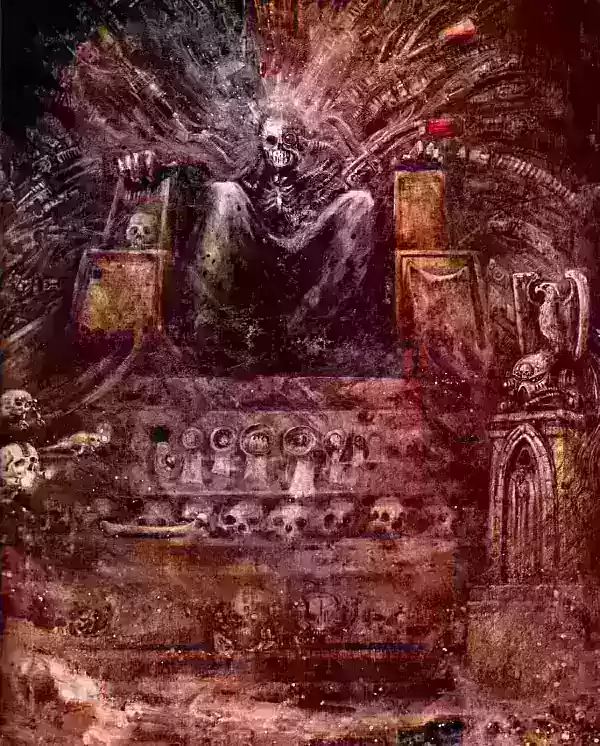
The iconic depiction of the God-Emperor by John Blanche, shown below, is etched into the memory of every Warhammer 40,000 fan. This is the Emperor as he is known in the 41st millennium: grim, bleak, and almost ethereal.
But is this what the Emperor actually looks like in the lore? The final story in Era of Ruin, "The Carrion Lord of the Imperium" by Aaron Dembski-Bowden, is also its most compelling. It suggests the familiar image of the God-Emperor from Blanche's art is merely that—an image crafted within the setting itself.
Near the conclusion of "The Carrion Lord of the Imperium," the Custodian Prefect Diocletian Coros visits the Emperor at an unspecified time, seemingly centuries after the Horus Heresy. Here, the narrative takes a provocative turn:
"Through the doors, the secret ones behind the celebrated gates adorned with glorious ornaments," the text reads. "Past the graven image of the Immortal Emperor: a skeletal sorcerer enthroned in terrible majesty, forever poised on the brink of death.
"Through that final portal, which opens only to a tribune's blood and whose unyielding locks require an hour to disengage."
Let's pause here for a moment. This passage implies the popular conception of the Emperor on the Golden Throne—the vision shaped by Blanche’s artwork—is the "graven image" referenced in the book. It is an image both in reality and within the Warhammer 40,000 universe: a piece of propaganda. And not propaganda meant for humanity, which the text notes has not ventured this deep into the Imperial Palace for generations. It is a facade for the audience, and for all but a select few characters in the narrative.
This raises the question: if this is not the true appearance of the Emperor, what does he actually look like? Let’s continue:
"Inside the innermost sanctum, where the walls have an unsettlingly organic, almost spinal architecture. Diocletian approaches the Golden Throne in its truest form, and his brethren—clad only in cloaks, loincloths, and black helms—part in respect as he passes.
"He ascends the steps. Slowly. With reverence, yes, but not the abject worship demanded by the Imperium's masses. They would be appalled by its absence; but then, everything about this place would horrify them. That is why they are never permitted to know of it.
"At last, Diocletian stands before his king.
"He looks past the hanging cables like viscera, the clicking and ticking life-support machinery, and the preservative mist sprayed at nine-second intervals. He looks past the blood bags and vitae-packs connected by tubes to the form upon the throne—a mere chair compared to the grand artistic renderings: a throne in function but not in the mythic, capitalized sense that makes it both a curse and mankind's salvation.
"He looks upon the revenant shell of something that was once, and somehow still is, a man. A thing that should not be alive, and by any mortal standard arguably is not. A being tormented by its own impossible endurance—physically emaciated yet psychically engorged from the daily feast of souls it is compelled to consume throughout its endless, agonizing existence.
"Or is it compelled? Perhaps it desires this. Perhaps it thirsts."
There is more to this final section, but the essential details are here: the Emperor described is starkly different from the figure in Blanche's art ("a throne without the capital T"). We read of black-helmed Custodians standing guard, "hanging wires that resemble intestines," blood bags, and preservative mist.
Some fans are convinced this passage describes a very early piece of Warhammer 40,000 art from the 1987 Rogue Trader rulebook (the game's first edition). That illustration shows the Emperor in an entirely different context, complete with a blood bag, mist, visceral cabling, and those same black-helmed Custodians.
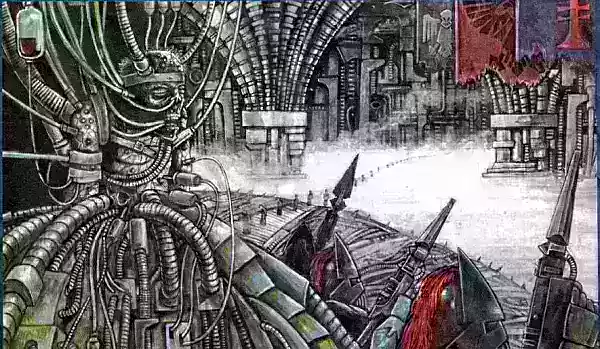
It's clear Warhammer 40,000 lore fans are enthralled by this short story. Not only does it reference two classic depictions of the Emperor—potentially elevating both to canonical status—but it embodies the grim-dark essence that defines 40K. If this interpretation holds, Era of Ruin revives a 28-year-old artwork, making it not just relevant to the 2025 setting, but central to a dramatic revelation about the Emperor's true nature.
In fact, the legendary John Blanche himself has previously discussed this in interviews, stating that his art was never intended to show the "real" Emperor. Instead, it was meant to depict the icon seen by pilgrims arriving on Terra, believing they were in the presence of their God. The "true" Emperor, Blanche suggested, lies hidden behind this facade, contained within a glass tube and connected to complex machinery. In this light, Warhammer 40,000 fans have been presented with an illusion.
Black Library author Dan Abnett, who has shaped much of the foundational Warhammer 40,000 lore, has expressed similar ideas in interviews, even questioning whether a throne room exists at all.
Whatever grand design Games Workshop has for the Emperor—with some speculating he may be slowly awakening—fans can confidently say that Era of Ruin offers the most explicit depiction yet of the Golden Throne and the decaying being within it. Even more excitingly, it revitalizes classic early Warhammer 40,000 art, integrating it into the modern canon as the game's future continues to unfold.